FRACTAL Index: The Variable No Spreadsheet Addresses
Great news. An analyst review of a Bolivia-focused mining company published this week described political and legislative risk as “the one variable no spreadsheet addresses” — the material gap between a $2.65 billion valuation model and the operational work that stands between that model and an actual mine.
The framing is precise. It also captures, without naming it, the exact reason the FRACTAL Index exists.
There is an additional layer worth noting. The analysis was not produced by a human analyst. It was generated by an AI system built on a five-factor analytical engine — relative valuation, growth, profitability, momentum, and estimate revisions — and reviewed by an editorial team. What this means is significant: even automated market analysis systems are now flagging political risk in Bolivia as the material variable — but without the capacity to quantify it. The AI reads the gap correctly. It cannot close it.
That is where the FRACTAL Index enters.
For decades, the finance industry treated political and institutional risk as a residual — something contextual, something to hedge, something to describe in a memo footnote. That treatment worked when the base case was stability and the tail was the exception. It doesn’t work anymore. In Latin America, political and institutional dynamics are no longer the tail — they are the base case. The tail is the fiscal adjustment executed on schedule, the legislative ratification granted without amendment, the transition of government completed without erosion of investor confidence.
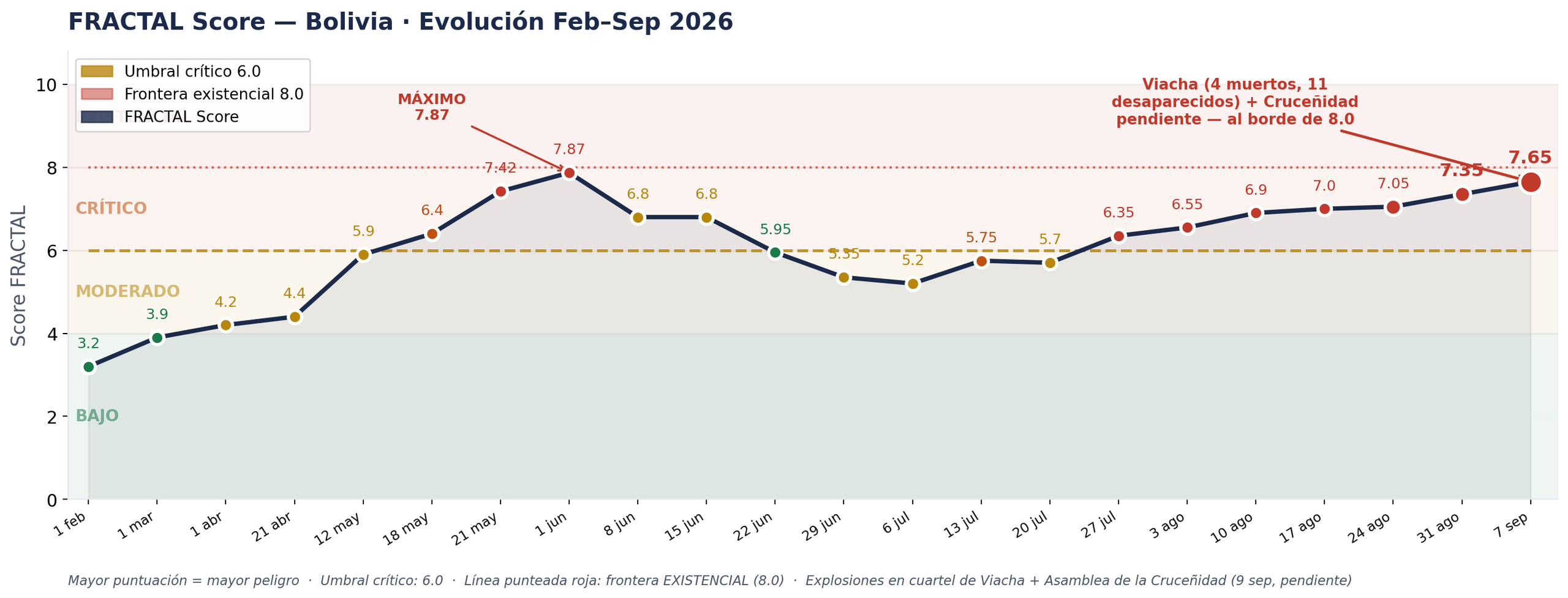
The FRACTAL Index quantifies that base case week by week. Eight weighted variables, a composite score adjusted by each country’s institutional resilience, and a systematic reading of Bolivia, Argentina, Colombia, and Peru. It does not replace the financial model. It closes the gap the model leaves open.
Higher score, greater danger. Every Monday morning.