The Unfinished Business with Iran in Bolivia
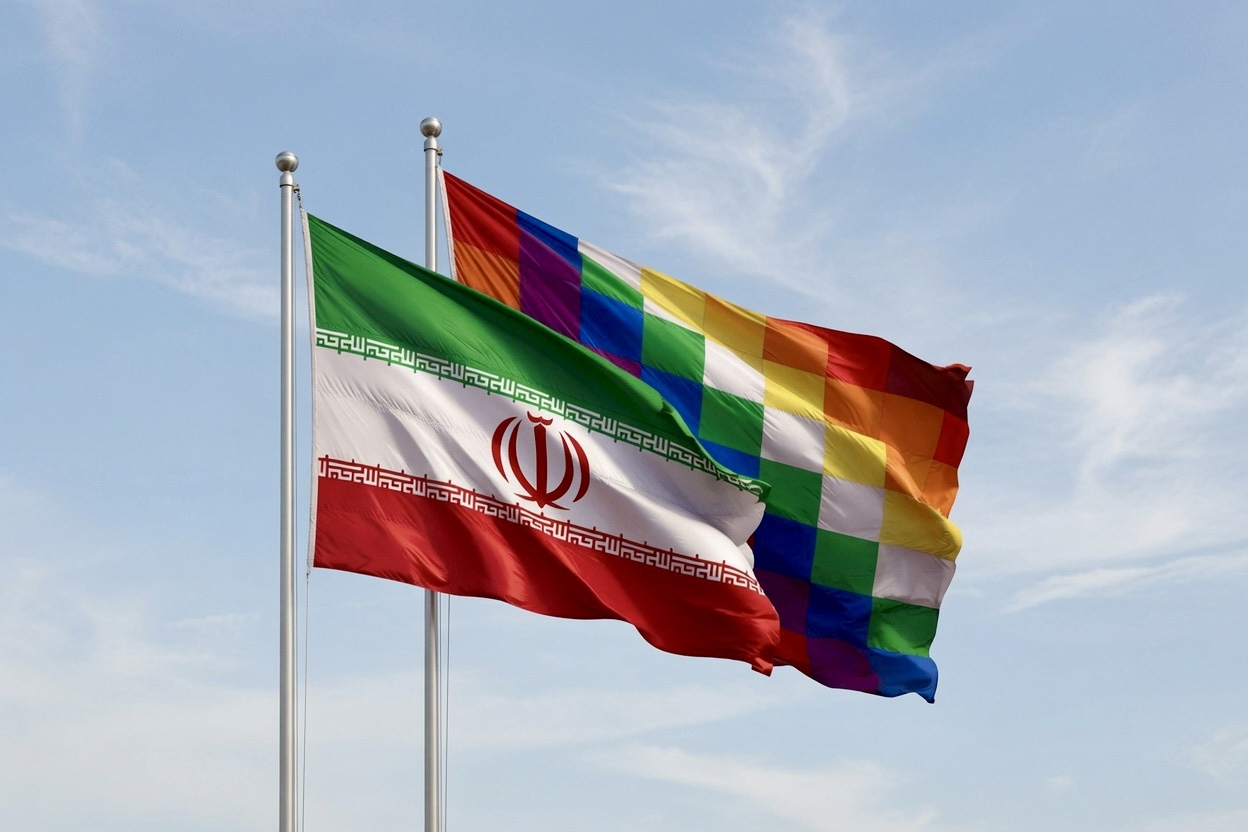
Bolivia is going through a severe multidimensional crisis — fiscal, energy, and institutional. But there is another crisis that never appears in the economic headlines and that may nonetheless be the most consequential for the country’s future and for the stability of the neighborhood. It is the Iranian presence on Bolivian soil, built over at least 18 years under the governments of the Movimiento al Socialismo, which survives largely intact despite the change of government in November 2025.
This article documents that presence milestone by milestone, to grasp the true dimension of the problem — and as a warning.
The Underestimated Platform Built Between 2007 and 2012
It all begins in September 2007. Mahmoud Ahmadinejad lands in Bolivia on a Venezuelan aircraft — the logistical detail already says everything — and becomes the first Iranian president to set foot on Bolivian soil. Evo Morales calls him “dear brother.”
The two sign a cooperation plan worth $1.1 billion in hydrocarbons, mining, agriculture, and infrastructure. Iran joins a study committee on lithium — uranium, of course — at the Salar de Uyuni.
The world registers it as yet another anti-imperialist gesture in the ALBA gallery, which turns out to be the first diagnostic error. What begins in 2007 is not mere rhetoric against the United States, but the construction of an entire Iranian forward platform.
Between 2009 and 2011, Iran installs — with Venezuelan funding — three milk-processing plants under the Lacteosbol brand, in Ivirgarzama (Chapare), Achacachi, and Challapata. Three million dollars. Eighteen thousand liters of daily capacity per plant. All located in Morales’ electoral strongholds. The Iranian Red Crescent also inaugurates a seven-story hospital in El Alto and ophthalmological clinics. “Bolivia will be the center of the Iranian Red Crescent on the continent,” the Tehran chargé d’affaires declares.
Where are those plants today? Are they operating? Who controls them? Nobody knows. No Bolivian government — not the MAS itself, not Jeanine Áñez, not Rodrigo Paz — has published an inventory, an audit, or even a statement on the state of that infrastructure and its activities. Opacity is the constant.
In 2011 the most revealing milestone of all occurs — one that should have triggered every regional alarm and didn’t. General Ahmad Vahidi, Iran’s Defense Minister, visits Santa Cruz to inaugurate an “anti-imperialist” military school where Iranian instructors would train Bolivia’s Armed Forces — designed, in Morales’ own words, to “build an anti-colonial and anti-capitalist worldview that links the armed forces with social movements and counters the influence of the School of the Americas.” Vahidi is wanted by Interpol for his alleged direct role in the 1994 AMIA bombing in Buenos Aires, which killed 85 people — 8 of them Bolivian. Bolivia receives him with full state honors. The Argentine DAIA protests. Morales ignores the complaint. Vahidi later rises to head of the Islamic Revolutionary Guard Corps (IRGC). Argentina designates the IRGC a terrorist organization in 2024.
Put plainly: the Morales government received with military honors the man presumed responsible for the murder of its own citizens at the AMIA. That is not a diplomatic mistake. It is a statement.
In 2012, Ahmadinejad’s third and final visit. Iran donates the complete equipment for Abya Yala TV, turnkey: approximately three million dollars in broadcast technology. The channel, tied to the Juan Evo Morales Ayma Foundation, has since operated with an anti-imperialist editorial line aligned with Tehran, Moscow, Caracas, and the Evo movement. Journalist Raúl Peñaranda documents it in his book Control Remoto as one of the media outlets purchased by the MAS government with foreign money.
Abya Yala TV is still on the air in 2026.
The Military Agreements Under Arce
If the Morales era built the civilian layer of penetration — milk, health, media, mosques — the Arce era (2020–2025) militarized it.
In June 2022 an episode occurs that deserves far more attention than it received: the Emtrasur aircraft case. The plane belonging to Venezuela’s Conviasa subsidiary, with a mixed Venezuelan-Iranian crew — several members linked to the IRGC — is detained in Buenos Aires. The Arce government intervenes: it uses the state airline BoA to transfer part of the crew to Santa Cruz. A second Venezuelan-Iranian aircraft operates in Bolivian territory during the same incident. Bolivia was not a bystander. It was an active node in the axis’s logistics network.
On July 20, 2023, Defense Minister Edmundo Novillo flies to Tehran and signs a memorandum of understanding on security and defense with General Mohamad Reza Qarai Ashtiani. The Bolivian government presents it as technical cooperation for border control and counter-narcotics. The Iranian minister describes it differently, stating that it includes the sale of military equipment, personnel training, Shahed drone deliveries, and intelligence sharing. The Washington-based Institute for the Study of War (ISW) confirms the drone clause.
The agreement is signed without parliamentary debate. The clauses are never published. The opacity is total.
And note who signs for Iran: Ashtiani is the direct successor of Vahidi — the AMIA suspect — in the chain of command of Iran’s Defense Ministry. The institutional continuity of the Bolivia-Iran bond is not accidental. It is deliberate.
The Argentine and Chilean Warnings Bolivia Chose to Ignore
In April 2024, Argentina’s then-Security Minister Patricia Bullrich raises the border alert with Bolivia to its maximum level. Her declarations are precise and grave: “Bolivia has allowed the installation of 700 Iranian nationals whom we consider to be members of the Quds Force, the armed branch of the Islamic Iranian state.” She also investigates the possible issuance of Bolivian passports to citizens who don’t even speak Spanish.
The Arce government summons the Argentine ambassador, calls the statements “mistaken and reckless,” and denies everything. Bolivian immigration denies the passports. Evo Morales attacks Milei. The figure of 700 individuals is never verified or refuted with public evidence.
In October 2024, Bullrich goes further, denouncing the operational presence of Hezbollah in Bolivia. Chilean authorities express concern over Iranian elements near the border. The Israeli embassy in Buenos Aires alerts the region to the pattern of Iranian penetration using Bolivia as a platform.
The full picture — Vahidi in Santa Cruz, Emtrasur, the defense agreement, the Red Crescent, Abya Yala, state-promoted mosques, 700 unidentified Iranians — no longer permits talk of simple bilateral cooperation or anecdote. It is systematic, layered penetration, designed with strategic patience. In the terms of the FRACTAL Index, it is a textbook case of asymmetric influence over a fragile society — a postmodern coup in progress.
Bolivia is, alongside Venezuela, one of only two countries in Latin America where Iran has had direct military cooperation. That is not a minor detail on the hemispheric security map.
The Paz Government Commits — But Does Not Act
On November 8, 2025, Rodrigo Paz takes office as Bolivia’s president. Before the inauguration, he meets in Washington with Secretary of State Marco Rubio. “Bolivia opens itself to the world,” he declares. The shift is real: he restores relations with Israel (broken by Arce in 2023), announces the return of the DEA — expelled by Morales in 2008 — and participates in the “Shield of the Americas” summit at Trump National Doral in March 2026, joining the regional coordination mechanism on defense and intelligence with twelve countries.
In January 2026, Reuters reveals that Washington is formally pressuring Bolivia to expel the IRGC’s alleged spies operating in the country and to designate the IRGC, Hezbollah, and Hamas as terrorist organizations. It is an explicit demand, with identified sources inside the U.S. government.
In April 2026, Defense Minister Marcelo Salinas confirms that the military agreement with Iran “was formally renounced approximately four months ago” — meaning December 2025. The agreement is formally dead.
So far, so good. The initial steps Paz has taken on this front are correct, but also deeply insufficient. The question Bolivia — and the neighborhood — must answer is what lies behind the paperwork.
The Six Unfinished Tasks of the Paz Government
Six months into his term, the security balance on the Iran file is critical.
One. Bolivia has not designated Hezbollah, Hamas, or the IRGC as terrorist organizations, despite explicit pressure from Washington. This is the gravest omission and the hardest to justify within the logic of the strategic shift that Paz himself proclaims.
Two. There is no public record of any Iranian national linked to the IRGC having been identified, investigated, or expelled. The January 2026 demand remains without any verifiable operational response.
Three. The complete clauses of the 2023 military agreement remain unpublished. The Paz government has opened no investigation into what was actually executed during the months the agreement was in force — July 2023 to December 2025. The MAS opacity is preserved intact.
Four. Abya Yala TV remains on the air. Its Iranian funding structure, its ties to the Morales Foundation, and its pro-Tehran editorial line have not been subject to any public review under the Paz government.
Five. The Iranian civilian cooperation projects — hospitals, clinics, milk plants — have not been audited. Their operational status, their personnel, and the whereabouts of Iranian equipment at those facilities are unknown.
Six. The case of the 700 Iranians with possible Bolivian passports, denounced by Argentina in 2024, was never transparently investigated by any Bolivian government.
The Chapare: The Node That the Central Government Does Not Control
In May 2026, Iranian Ambassador Bahram Shahabeddin and Russian Ambassador Dmitry Vérchenko travel to Cochabamba for the inauguration of Governor Leonardo Loza, a coca-growing leader and one of the main evista allies. Evo Morales announces the Iranian ambassador’s attendance on his radio program with evident satisfaction.
In his first speech as governor, Loza declares: “How could we not work with Iran, with Russia, with China.”
Ambassador Shahabeddin goes further, expressing his wish that “Cochabamba has to become the capital of Bolivia” — a statement that triggers a diplomatic incident, the summoning of both ambassadors by the Foreign Ministry, and Shahabeddin’s subsequent retraction.
The episode is far from anecdotal. The Chapare is precisely the zone where Iranian milk plants were installed in 2009 and 2010. It is Morales’ historic stronghold. It is the region where, according to Argentine intelligence, IRGC elements are said to operate. And now it has a governor who opens his term with a speech of alignment with Tehran and Moscow.
Paz’s diplomatic shift operates in La Paz. The Iranian network operates in the Chapare. These are two parallel realities that the central government has not yet reconciled.
Why This Matters Now — And Why It Concerns the Neighborhood
Bolivia is going through the worst crisis in its recent history. International reserves are at historic lows. The exchange rate is under pressure. The fiscal deficit almost reaches 11% of GDP according to independent estimates. The state cannot service its debt without accessing markets at rates of 9.75%. The energy crisis has turned the country into a net hydrocarbon importer.
In that context of extreme fragility — exactly the kind of environment the FRACTAL Index identifies as of maximum vulnerability to asymmetric influence — the presence of an Iranian network with anchors in media, civilian infrastructure, the coca movement, and possibly in military structures inherited from the MAS is not a foreign policy problem. It is a national and regional security problem.
For the neighborhood — Argentina, Brazil, Chile, Peru, Paraguay — Bolivia in this condition is a risk vector. An Iranian platform at the geographical heart of South America, sharing borders with five countries and without demonstrated capacity to dismantle the network it sheltered for two decades, is precisely what regional and Washington intelligence services must track with sustained attention.
The United States knows all of this. The pressure reported by Reuters in January 2026 is not a strategic surprise — it is confirmation that Washington has the complete map. What the U.S. needs in Bolivia is not only a president with good intentions — it already has that with Paz — but a partner with real operational capacity: functional intelligence, armed forces cleared of MAS cadres with Iranian ties, and the political will to fulfill uncomfortable commitments such as the designation of Hezbollah as a terrorist organization.
That operational capacity has not yet been demonstrated. And time is not neutral: every month that passes without identifying IRGC agents present in Bolivia, without auditing Abya Yala, without publishing the clauses of the 2023 agreement, is a month in which the network consolidates positions under a government that, paradoxically, no longer protects it — but has not dismantled it either.
The Iranian Trail Will Not Disappear on Its Own
Canceling a military agreement is an administrative act. Dismantling an influence network built over 18 years is an intelligence operation, requiring sustained political will and institutional control — and it does not appear to have begun in earnest.
Bolivia today has a government with the right orientation but lacking the will to act. What is missing is execution. And execution in counterintelligence cannot be improvised, cannot be delegated to the goodwill of ambassadors summoned to the Foreign Ministry, and cannot be resolved with uncomfortable photographs at Doral.
The Iranian trail in Bolivia — the plants, the hospitals, the channel, the mosques, the 700 nameless Iranians, the secret clauses of the defense agreement, the Chapare with its evista coca governor receiving the ambassador of Tehran — is an open file. Tracking it rigorously, documenting it, and demanding answers is a task that belongs not only to Bolivia, but to every country in the region that shares with it a border, a risk, and an interest in a Latin America free from the influence of regimes that export terrorism as an instrument of foreign policy.
This column is part of that effort.
Mauricio Ríos García is a Bolivian economist, author of Auge y Decadencia de Bolivia (2003–2023), Incautos (2017), and La década perdida de Occidente (2015), and Editor-in-Chief of Macro Alertness (riosmauricio.com). He is the creator of the FRACTAL Index (Fragility & Risk Assessment of Asymmetric Conflict Threats Across the Americas and Liberal Societies), an analytical framework for evaluating asymmetric threats and institutional fragility in liberal societies of the Western Hemisphere.