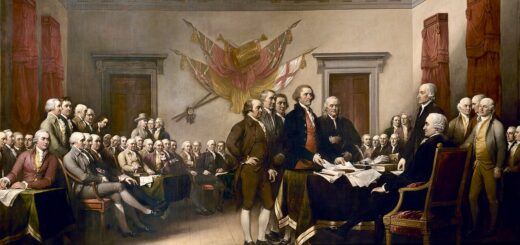
The Fruit of the West: 250 Years of the Declaration of Independence
July 4, 2026 marks 250 years since a document that changed the course of human history more than almost any other: the Declaration of Independence of the United States. The commemoration, predictably, will fall short. There will be talk of fireworks, of Philadelphia, of Jefferson, perhaps of the war against Great Britain. What almost no one will say—because almost no one knows it, or because almost no one finds it convenient to know it—is that this text is not an exclusively Anglo-Saxon invention, and that its impact was never confined to the thirteen colonies. It was, and remains, the most important event in the entire Western Hemisphere, and probably in the world. And above all, it was the point where traditions of individual liberty that had been developing in different corners of the West for centuries converged—with a Hispanic protagonism that the dominant historiography prefers not to underline.
Let’s start with the obvious. No other political experiment in history has produced a level of prosperity, innovation, and individual freedom comparable to that of the United States over these 250 years. That is not chance, nor racial or geographic superiority: it is the direct result of having institutionalized, better than anyone before, a set of principles—limits on power, private property, the rule of law, popular sovereignty—that took centuries to mature. The impact of that institutionalization did not stay within American borders. It was exported, imitated, translated into constitutions across half the world, including Latin America itself. Without July 4, 1776, the twentieth century would have been different, and probably far worse, for the whole of the West. That needs to be said without complexes.
Now let’s get to what almost no one says. The Declaration of Independence did not come out of nowhere, nor is it an exclusively Anglo-Saxon product with a dash of French seasoning. Before Locke, before Smith, before Jefferson, there was a school of thought already two centuries ahead: the School of Salamanca. Francisco de Vitoria, Domingo de Soto, Juan de Mariana, Luis de Molina. These were not obscurantist theologians doing parlor philosophy. They were the first to rigorously defend private property as a necessary institution, the subjective theory of value—three centuries before the Austrian School claimed it as its own—the moral legitimacy of voluntary commerce, and something even more radical: the right of resistance against the tyrant, including tyrannicide, which Mariana developed in De rege et regis institutione (1599) with a forcefulness no Scottish Enlightenment figure ever dared to match.
Those ideas did not stay in Spain. Locke inherited them, secularized them, and gave them the individualist turn that made them fit for political modernity. And from Locke they passed directly to Philadelphia. Jefferson kept Mariana’s Historia General de España in his library and recommended it to friends; he even bought copies for Madison. John Adams studied De rege et regis institutione closely. The natural equality of men, the original sovereignty of the people, consent as the source of political power, the right to resist the tyrant: everything we read in the preamble of the Declaration has a genealogy that runs through Salamanca before it runs through Edinburgh. This is not an erudite curiosity. It is the fact that changes the story we were told.
And there is more still, because the Hispanic contribution to American independence was not only intellectual. It was military, logistical, and paid in blood. When Spain declared war on Great Britain in 1779, the American cause had been stalled for four years. Bernardo de Gálvez, governor of Louisiana, took Baton Rouge, Mobile, and Pensacola between 1779 and 1781, drove the British out of the south, and cut off the rear supply lines Cornwallis needed to resupply. Without those campaigns, Yorktown—the moment that sealed independence—would have been, at best, far more difficult. Spain also provided loans, weapons, uniforms, and soldiers from Cuba, Mexico, and Puerto Rico. American independence was not an exclusively Anglo-Saxon feat with occasional Spanish help. It was a shared Atlantic enterprise, and Gálvez’s coat of arms motto—Yo solo, “I alone”—remains, almost unknown to anyone, the official emblem of the city of Los Angeles.
Why does any of this matter in 2026, beyond historical anecdote? Because the right conclusion is not that the United States owes Spain something, nor that history needs to be rewritten to hand out credit like prizes at an awards ceremony. The right conclusion, and a far more powerful one, is that the United States became the crucible where the traditions of individual liberty from across the entire Western Hemisphere converged: the Hispanic tradition, with its reflection on the moral limits of power; the Anglo-Saxon tradition, with its rule of law and institutional genius; and the French tradition, with Cantillon and Turgot refining the theory of value and entrepreneurship before Smith systematized it all in 1776. The United States did not invent Western liberty. It received it from several traditions at once, and its merit—one no one can take away—was translating it into institutions that endured.
This carries an implication that, in Latin America, we still fail to accept with the naturalness it deserves: we are not bystanders to the feat of 1776. We are, to a significant degree, its intellectual and military co-authors. The liberty institutionalized in Philadelphia has Hispanic roots as deep as its Anglo-Saxon ones, and celebrating the Fourth of July without acknowledging that means accepting, once again, the Black Legend we were taught to internalize: the idea that the only thing we contributed to the West was backwardness, while the Anglo-Saxons contributed progress. That is false, and it is a costly falsehood, because it deprives us of the self-esteem needed to recognize ourselves as legitimate heirs of the same tradition being celebrated today in Washington.
And here lies what is truly urgent about this anniversary. The West—understood not as an ethnic bloc nor as the property of a single country, but as that shared intellectual conversation among Spain, England, France, and America—is being challenged today with an aggressiveness that has no recent precedent, and not primarily from outside, but from within: from the universities, institutions, and public discourse of the very societies that tradition built. This erosion does not advance with armies. It advances with narrative, with retroactive guilt, with the pretense that acknowledging that civilization’s achievements amounts to whitewashing its errors. That is false. One can—one must—recognize slavery as the original sin of the American founding, and at the same time recognize without complexes that no other political project has been capable of correcting itself with the consistency the United States has shown.
That is the shared spontaneous tradition we have in the West, and one we should claim precisely because it is under attack as never before: the limitation of power, private property, voluntary exchange, individual dignity as the foundation of all political order. These are not Anglo-Saxon property alone. They belong to us too, to Latin America, because they emerged in part from our own intellectual tradition before crystallizing in Philadelphia. If those values deteriorate or are destroyed—and they are deteriorating, no exaggeration needed to see it—the cost will not fall on the United States alone. It will fall on the entire hemisphere, and probably on the whole world, because there exists today no remotely comparable institutional alternative capable of sustaining the prosperity and freedom that tradition made possible.
At the 250-year mark of 1776, what is called for is neither nostalgia nor hagiography. What is called for is recognizing, without complexes, that the United States is the most accomplished institutional fruit of a tradition that is as much ours as theirs, and defending it with the same intellectual conviction with which Vitoria, Mariana, Locke, and Jefferson built it. Several countries, one nation. That nation turns 250. And we still have a great deal to lose if we let it keep being claimed exclusively by those who only want to destroy it.