Bolivia Is Not “Right-Wing.” It’s Ungoverned
A recent piece in The Epoch Times, “For Decades, the United States Ignored Latin America. All That Changed Under Trump,” authored by Darlene McCormick Sanchez, places Bolivia among five countries that have supposedly “flipped from left to right” since Donald Trump’s re-election, part of a broader hemispheric realignment the article calls the “Donroe Doctrine.” It is a useful piece for tracking the region’s electoral pendulum. It is also, in Bolivia’s specific case, the wrong tool for the job — and the reason why says something important about how risk in this region should actually be measured.
Rodrigo Paz Is Not Javier Milei
Start with the premise itself. Javier Milei took the stage in Davos this January to sign Trump’s Peace Council charter, called Nicolás Maduro a “narco-dictator, murderer” in the same breath he praised Washington’s Venezuela operation as “excellent,” and posted “Liberemos las Américas. MAGA” to his own followers. That is ideological alignment, stated in the man’s own words, without qualification.
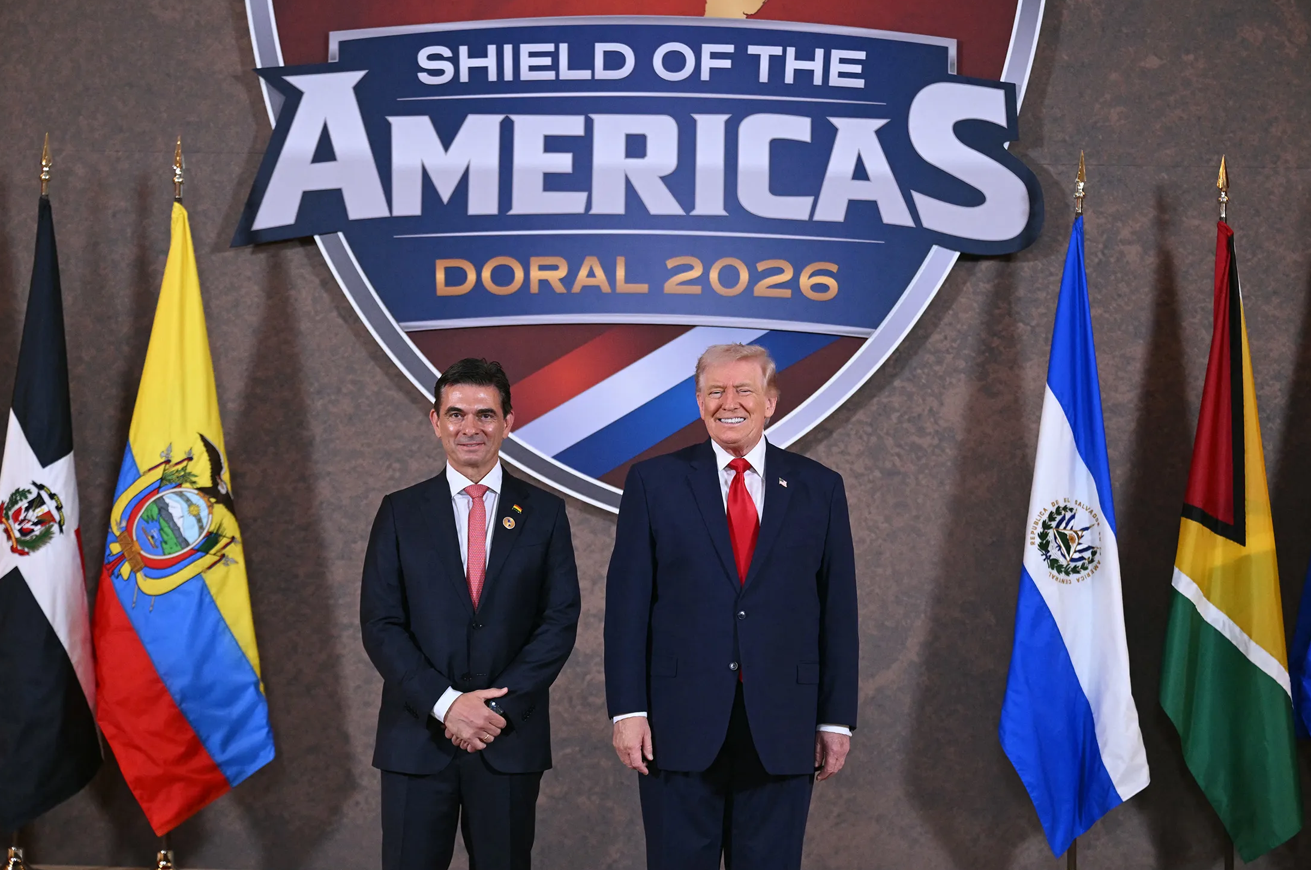
Rodrigo Paz has done none of that, and I wrote as much in real time back in May, before any of this month’s crisis had unfolded. When Paz was first summoned to the Shield of the Americas summit at Trump National Doral, his own reported reaction was to treat it as an inconvenience rather than an opportunity: “voy a tener que ir, ¿no?” — “I suppose I’ll have to go” — as if a hemispheric security and defense forum were little more than an errand to shake loose some infrastructure financing. That is not the posture of a leader who sees Washington as an ideological home. It is the posture of a small-town mayor mentally filing a mandatory meeting under obligations, not alliances. The deeper problem, as I argued at the time, is that Paz was sold to Bolivian voters as a man of the right “cuando ni él mismo se lo cree” — when he does not believe it himself. That packaging turned out to be a gift to the radical left: it let the old Socialismo del Siglo XXI apparatus frame every subsequent failure as the failure of “the right,” when what actually failed was a government that chose image-building over governing from its first week in office.
The clearest test of whether Paz’s alignment with Washington is conviction or convenience is not the summit photograph. It is what he actually did with the security relationships the MAS government left behind. Here the record is not ambiguous — it is a pattern I documented in detail in June: correct declarations, with almost no operational follow-through. Paz restored ties with Israel, announced the return of the DEA, and formally renounced Bolivia’s 2023 military cooperation accord with Iran. All real, all positive. But eighteen years of Iranian civilian and military infrastructure — the “anti-imperialist” military academy Tehran built in Santa Cruz, the state television channel it fully equipped and that still broadcasts today, the hundreds of Iranian nationals Argentina’s own security ministry once flagged as Quds Force-linked — remain untouched. Hezbollah, Hamas, and the IRGC still have not been designated as terrorist organizations, despite direct pressure from Washington reported since January. And when Iran’s ambassador showed up in the Chapare this May to help install an evista governor who opened his term declaring alignment with Tehran, Moscow, and Beijing, the government’s response was silence. You do not get to claim the ideological right’s foreign policy credentials while leaving the previous government’s actual foreign infrastructure fully intact. Paz commits. He does not execute. That is not a right-wing government. It is a government still deciding whether it wants to govern at all — and I said so months before a single minister was censured or a single presidential adviser was led away in handcuffs.
This distinction is not academic. It matters for exactly the reason The Epoch Times piece exists: to help readers understand where the region’s risk actually sits — and it is worth noting that Bolivia’s own bond market began pricing in exactly this credibility gap as far back as May, well before this month’s headlines, precisely because unresolved security questions translate directly into sovereign risk.
The Supermajority That Isn’t One
Here is where McCormick Sanchez’s broader framing does real damage. Her article states that in Bolivia, conservative factions together form a supermajority in both legislative chambers, with the former left-wing government reduced to two seats. As a description of the ideological map, this is accurate. As a description of the government’s capacity to govern, it is almost the opposite of true.
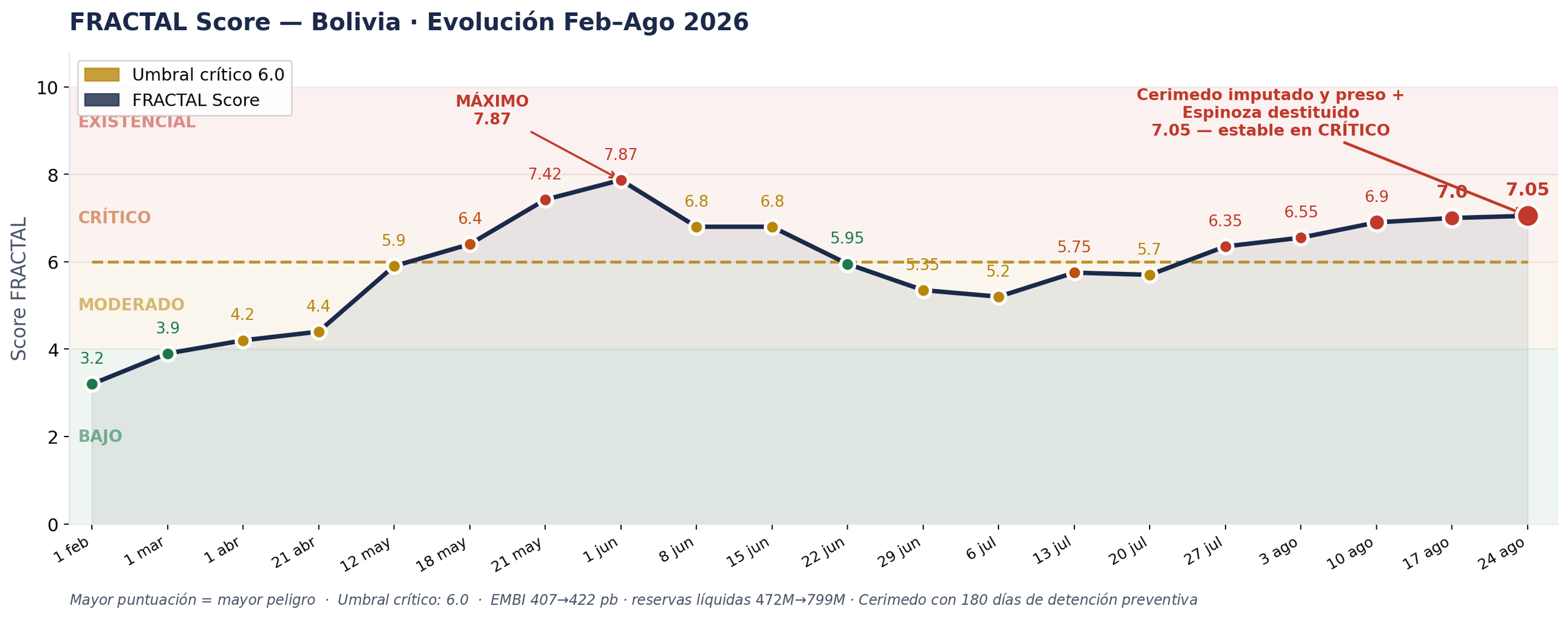
Since late July, the FRACTAL Index — the weekly risk index built specifically to track Bolivia’s institutional fragility — has recorded exactly the opposite trajectory that a “conservative supermajority” story would predict. Unidad, the party that gave Paz’s coalition its working majority, formally broke and joined the opposition on July 23. The government’s own vice president filed a criminal complaint against his own economy minister on August 12. That minister was censured by the Legislative Assembly and formally removed by presidential decree on August 21, over a dispute that includes allegations tied to how sovereign bonds were placed and whether the legislature’s required authorization was ever secured. The president’s own personal communications adviser was formally charged with attempted femicide and is now serving 180 days of pretrial detention, with a separate corruption investigation opened into his finances. A president’s most senior police commander told a reporter, on the record, that arresting the country’s most powerful opposition figure “is not a priority,” and was publicly overruled by his own interior minister hours later.
None of that is a left-right story. All of it happened inside a coalition McCormick Sanchez’s piece would classify as part of the hemisphere’s rightward shift. The accompanying FRACTAL Score chart, tracking Bolivia week by week since February, shows the country crossing its critical threshold in late July and climbing steadily past 7.0 through August — a trajectory driven almost entirely by internal fracture, not by any leftist opposition mounting a comeback. The “supermajority” is real on paper and has proven close to irrelevant in practice, because a shared position on the ideological map does not translate into a shared capacity to govern together.
Why This Is the Case for a Different Kind of Index
This is precisely the blind spot that a left-right paradigm cannot correct for, by default. It answers a different question than the one that matters to anyone with capital, personnel, or contracts exposed to a country like Bolivia. “Which direction did the government lean at the last election” tells you almost nothing about whether that government can pass a law, keep its own cabinet intact, or avoid a criminal investigation into its inner circle three weeks before a critical financing decision. FRACTAL was built to answer that second question directly — measuring legitimacy, unity of effort, external backing, and the specific mechanics of what we call “postmodern coup” pressure, week over week, regardless of which side of the aisle a government sits on.
Bolivia this year is the clearest possible demonstration of why that distinction is worth paying for. A regional analyst reading only the electoral map would have missed every one of the last five weeks. A reader following the FRACTAL Score would have seen each one coming — not as a surprise, but as the continuation of a trend already measured, sourced, and dated in the weeks before it made international news.
Mauricio Ríos García · FRACTAL Index · fractal-index.com
Bolivia no es de “derecha”. Es un país sin gobierno
El gobierno que eligió no gobernar
The Unfinished Business with Iran in Bolivia