The Weekly Risk Signal Latin America Actually Requires

How the FRACTAL Index measures political risk before it becomes price
Political risk in Latin America is no longer the tail of the distribution. It is the base case. The tail is the fiscal adjustment executed on schedule, the legislative ratification granted without amendment, the transfer of power completed without eroding investor confidence. This inversion has consequences that global risk platforms — designed for a world where the base case was stability — do not price correctly. Bolivia, Argentina, Colombia, and Peru are simultaneous case studies of that mispricing.
Consider Bolivia in 2026.
In February, the FRACTAL Score stood at 3.2. The country was in the low zone. External observers described a difficult but manageable macroeconomic environment. Sovereign spreads on the 2031 bond were elevated but stable. Consensus among global risk providers placed Bolivia in a category comparable to other stressed emerging markets — a country to monitor, not a country to price for institutional collapse.
By June 1, the FRACTAL Score had reached 7.87. Fifty days of coordinated road blockades. A state of emergency. A 40% devaluation of the boliviano. The sovereign spread on the 2031 bond hit 583 basis points — its historical maximum. The country transitioned from stressed to acute institutional crisis in approximately 100 days.
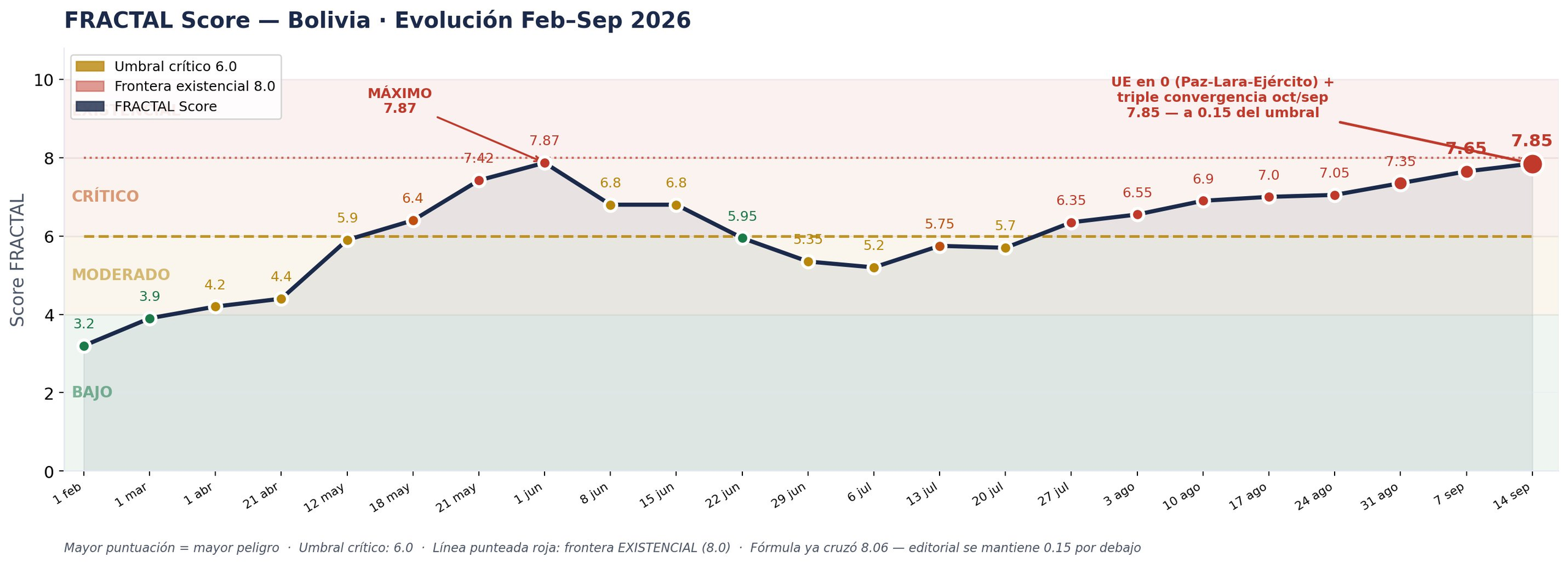
The point is not that Bolivia deteriorated. The point is that the deterioration was measurable in real time, week by week, through variables that global providers do not track at that frequency. Government legitimacy — the master variable in the model developed at the U.S. Army War College and applied here — began eroding in early April, weeks before headlines confirmed the crisis. External interference indicators moved before formal congressional confrontations. The postmodern coup variable — cultural warfare, lawfare, narrative erosion, an original addition to the SWORD framework — registered the escalating institutional pressure before it manifested in the streets.
A fund manager with sovereign debt exposure to Bolivia, informed by weekly readings of these variables, had actionable signal in April to review positioning, well before spreads reached historical maximums in June. A corporate operator with productive or logistical activity in the country had actionable signal to renegotiate contracts, adjust cash flow horizons, and prepare force majeure provisions before blockades made those decisions reactive. A private equity fund evaluating entry had actionable signal to postpone or restructure the entry timeline.
None of this required predicting the future. It required measuring the present, systematically, week by week, with a framework that captures the variables that actually drive institutional risk in Latin America. That is what the FRACTAL Index does.
The methodology is not proprietary opinion. It is built on part of a model developed at the U.S. Army War College across more than 40 documented cases of asymmetric conflict — extended with two original layers: external interference and the postmodern coup. Eight weighted variables produce a composite score, adjusted country by country through the Institutional Quality Index, because the same score reads differently depending on institutional resilience. Higher score, greater danger.
The subsequent arc reinforced the framework. From the peak of 7.87 on June 1, the score declined week by week to 5.20 by early July as the acute crisis passed and the country transitioned to a different, more persistent risk phase: operating under accelerating inflation with a freshly devalued currency. The index detected the descent while markets were still pricing the crisis. It has continued to move through August and September as legislative-executive tension, ministerial censure motions, and the fiscal adjustment debate reshape the operating environment for the country’s institutions and its private sector.
Argentina, Colombia, and Peru are being measured under the same framework. The Argentine fiscal consolidation under Milei is not evaluated as a political preference but as a set of institutional variables that can either sustain or fail under electoral pressure toward 2027. The Colombian transition after De la Espriella’s narrow victory is not analyzed as a partisan outcome but as a legislative arithmetic that determines whether the promised fiscal adjustment executes. The Peruvian electoral cycle produces measurable movements in institutional variables that connect directly to operational risk for mining, energy, and financial exposure.
Global risk providers cover Latin America in a paragraph of a quarterly regional report. Their frameworks are calibrated for a world where the base case is stability. In Bolivia, Argentina, Colombia, and Peru, that is no longer the case. The frequency of the reading needs to match the frequency of the movement. The framework needs to capture the variables that actually drive institutional risk. And the reading needs to arrive before the price does, not after.
That is what the FRACTAL Index delivers, every Monday morning, for the four countries currently under active coverage. Coverage expansion to additional Latin American jurisdictions is under development.
For funds, corporates, insurers, and institutions with material exposure to the region, the index is designed to close the gap that financial models and traditional country research leave open — the variable no spreadsheet addresses.
Pricing on request. Direct analyst access available.
Visit www.fractal-index.com
The Weekly Risk Signal Latin America Actually Requires
Situación crítica para Bolivia en el FRACTAL Index
FRACTAL Index: The Variable No Spreadsheet Addresses
Bolivia ante el default, el derrocamiento y el conflicto asimétrico
Bolivia no es de “derecha”. Es un país sin gobierno
Bolivia Is Not “Right-Wing.” It’s Ungoverned
Asymmetric Threat in an Andean Country
Los mercados ratifican la cautela del FRACTAL Index sobre Colombia
Confirmando lo advertido: el FRACTAL Score de Colombia supera el umbral crítico
Por qué el sector privado en América Latina debe invertir más en inteligencia de riesgo
Colombia valida el FRACTAL Index mientras Marco Rubio recompone la legitimidad externa